Biography
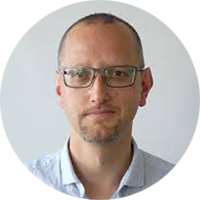
Shafir graduated in Chemistry from Hunter College (CUNY, USA), and obtained his PhD at UC Berkeley, USA (w/ J. Arnold) on redox-active metal complexes based 1,1’-diaminoferrocene ligands. He then joined the S. Buchwald laboratory at MIT to work on Cu-catalyzed C-N and C-O bond-forming reaction, reporting the first room temperature copper-catalyzed C-N coupling protocol, as well as a first ligand-controlled orthogonal copper-catalyzed C-N or C-O coupling. In 2006 A. Shafir received a Ramón y Cajal scholarship and moved to the Universitat Autònoma de Barcelona, where he went on to co-author publications in the fields of catalytic metal nanoparticles. There, he also launched a research program on hypervalent iodine reagents (e.g. JACS 2010), which began a key research topic in his group.
In 2013, Shafir obtained a 5-year Junior Group Leader position at the Institut Català d’Investigació Química (ICIQ) in Tarragona, where he established the Synthetic and Mechanistic Research laboratory. That same year he also represented Spain at the Young Investigator Workshop /EuCheMs (2013). The group’s interests involved catalysis and oxidative CH functionalization, particularly using hypervalent iodine reagents. Additionally, the team studied mechanistic aspects of iodane-promoted reactions, and also developed new methods for the synthesis of metal-organic frameworks. Importantly, the group’s results led to a very fruitful 3 year-long collaboration and contracts with the international agrochemicals company Syngenta Ltd (UK), with >€270,000 in funding to the research group and a 2019 joint patent. In 2014 the group received funding from the competitive grant (PI: Shafir, MINECO Plan Nacional). In 2017 he received the Thieme Chemistry Journal Award.
In 2018 Shafir was appointed Cientifico Titular (Tenured Scientist) of CSIC at the IQAC institute in Barcelona. Jointly with prof. A. B. Cuenca, he co-founded the BISI Bonds research group on synthetic methodology, supported through an on-going grant from Spain’s MINECO As part of the group’s activity, we reported a series of publications on the so-called “iodane-guided” ortho, and, more recently, meta and para C-H coupling reactions (ACIE 2019; ACIE 2020, ChemSci 2021, CHEM 2025). In Nov 2019, Shafir and Cuenca received the Arquímedes Award from the Ministry of Education as supervisors of the year’s the best Master Thesis in Chemistry in Spain awarded to Wei Chen; the student’s PhD study also received the RSEQ-Lilly award, and the Castells doctoral award from the local chapter of RSEQ.
To help address the societal aspiration towards Circular Economy, as of 2023 the group is part of a “Public-Private” consortium LULYPLAST funded with ~€800.000, aimed to recycle plastic waste through a pyrolysis-upgrade cycle. Recently, our team has also launched a program on boron-doped organic opto-electronic cores, with early results reflected in a series of publications in the last 2 years (Chem. Sci. 2024, Chem. Sci. 2025, JACS 2026), and in a proof-of-concept grant funded with >250 000 euros on large-scale synthesis of BN-doped materials (IP’s: A. Shafir, A. B. Cuenca. As of 2021, Shafir is the vice-president of the Catalan chapter of the Spanish Royal Chemical Society (RSEQ).
Plenary Lecture
Title: Reaction and structure development using hypervalent iodine
Abstract